For decades, student assessment has been stuck in a rut. We’ve relied on multiple-choice questions and standardized tests. These tools are easy to grade, but they fail to measure what truly matters. They can’t measure critical thinking. They can’t measure creativity. They can’t measure true understanding.
Now, a revolution is underway. AI in student assessment is changing everything. We are finally moving beyond the bubble sheet.
New AI education technology is doing what was once impossible: evaluating the quality of complex, open-ended answers. This isn’t just about saving time. It’s about creating a smarter, fairer, and more personalized learning experience for every student.
This guide explores how this technology works, why it’s so much better than traditional methods, and how AI grading systems 2025 are redefining the very idea of assessment.
The Limitations of Traditional Assessment
Traditional assessment methods are built for efficiency, not for learning. They are a product of an old system that needed a fast way to grade millions of students.
This system is failing us.
- It’s Shallow: Multiple-choice tests reward memorization, not deep, analytical thinking. A student can guess the right answer without truly understanding the “why” behind it.
- It Lacks Real-World Skill: The modern world doesn’t ask multiple-choice questions. It demands problem-solving, communication, and creative solutions. Traditional tests ignore these critical skills entirely.
- It Crushes Teacher Morale: Teachers are buried in paperwork. Studies show educators spend 30-40% of their time on grading and administrative tasks. This is a massive driver of burnout. Teachers signed up to inspire students, not to spend their weekends in a mountain of ungraded essays.
- It’s Slow: The “feedback loop” is broken. A student writes an essay, and two weeks later, they get it back with a few red marks. By then, the class has moved on. The learning moment is gone.
We have been forced to choose between what is practical (multiple-choice) and what is meaningful (descriptive assessment). AI finally allows us to have both.
How AI and ChatGPT Are Transforming Education
The biggest breakthrough is Generative AI. Large language models (LLMs) like ChatGPT in education are not just search engines. They are text-generation and analysis engines. They can read, understand, and evaluate human language with incredible nuance.
Natural Language Grading
This is the core of the revolution. An advanced AI grading systems 2025 can now grade essays and descriptive answers.
Here’s how it works:
- It Understands the Rubric: A teacher provides the AI with a detailed grading rubric. This tells the AI what to look for and how to score each element (e.g., “Argument Strength – 40%”, “Use of Evidence – 30%”).
- It Reads for Context: Unlike old keyword-matching software, modern AI reads for meaning. It understands context, sentence structure, and the logic of an argument. It can tell if a student is just “word-stuffing” or if they are making a genuine, well-supported point.
- It Provides a Grade and Feedback: The AI gives a precise score based on the rubric. More importantly, it provides detailed, constructive feedback for each criterion. It can explain why the argument was weak and suggest how to improve it.
Emotional & Creativity-based Evaluation
This is the cutting edge. AI is moving beyond just “correct” or “incorrect.” It’s learning to evaluate the quality of human expression.
- For Creative Writing: An AI can be trained to assess elements of a creative story. It can check for an engaging opening, vivid imagery, and strong character development, all based on the teacher’s rubric.
- For Persuasive Essays: It can analyze the use of emotional appeals (pathos), logical arguments (logos), and credibility (ethos).
- For Fostering Human Skills: The goal isn’t to let AI replace creativity. It’s to use AI to support it. AI can act as a thought partner, prompting students with questions that push them to think more deeply and critically. It’s a tool to help students overcome creative blocks and refine their original ideas.
Real-time Feedback and Learning Insights
This may be the most powerful benefit of all. AI in student assessment closes the broken feedback loop.
- Instant Feedback: Students get an evaluation the moment they submit their work, not weeks later. This “fail forward” approach allows them to learn from their mistakes immediately while the concept is still fresh in their minds.
- Personalized Learning: The feedback is tailored to each student’s specific gaps. This is the core of personalized learning AI. The system identifies why a student is struggling and can suggest resources to help them.
- Dynamic Learning: Real-time AI feedback makes students active participants in their own education. They can see their progress, set goals, and stay motivated.
AI Tools Leading the Change in 2025
This technology isn’t just theory. It’s here, and it’s being deployed in classrooms right now. These are the tools defining the new era of edtech innovation.
DeepGrade by AILogix
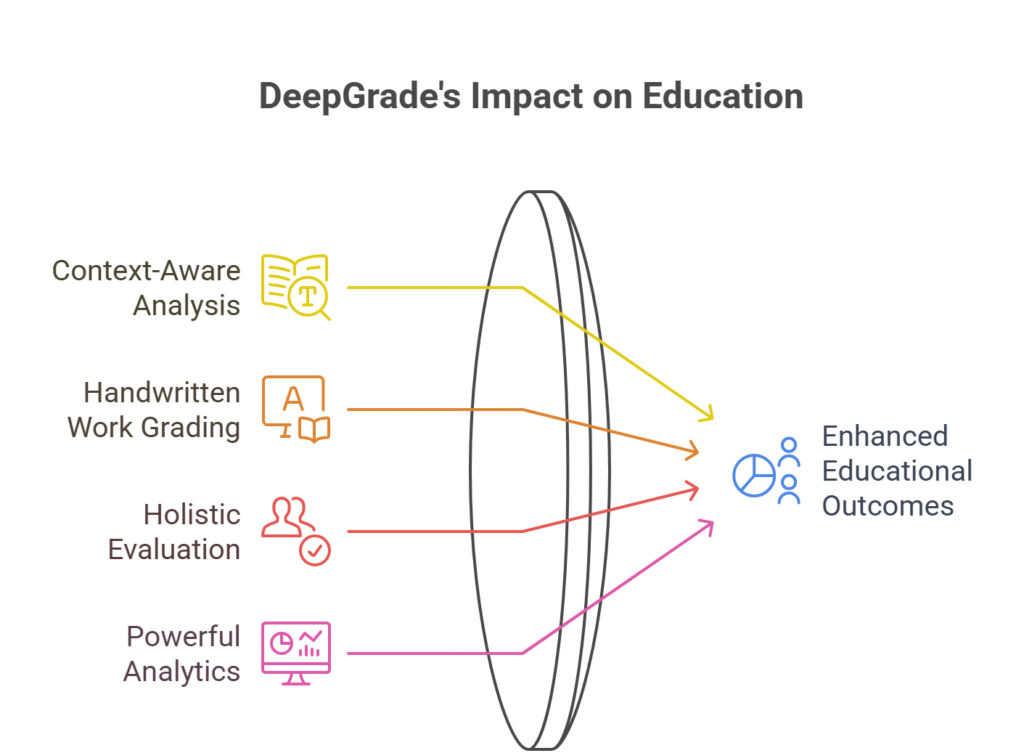
DeepGrade is a next-generation AI grading systems 2025 that is purpose-built to solve the challenge of descriptive assessment. It’s not a generic chatbot. It’s a sophisticated evaluation tool.
What makes DeepGrade different is its context-aware engine.
- Beyond Keywords: It doesn’t just scan for keywords. It understands sentence structure, meaning, and relevance to the question.
- Grades Handwritten Work: A massive challenge for traditional exams is the handwritten answer sheet. DeepGrade can scan and accurately evaluate handwritten answers, digitizing the entire process.
- Holistic Evaluation: It assesses all answer types, from essays and diagrams to mixed-format questions.
- Powerful Analytics: DeepGrade provides instant, detailed reports, including chapter-wise performance analytics. Teachers can see, at a glance, which concepts the entire class is struggling with, allowing them to adjust their lesson plans.
Adaptive Assessment Platforms
This is the next step in personalized learning AI. Adaptive platforms change the test, in real-time, based on the student’s answers.
If a student aces the first few questions, the AI will serve them more challenging problems. If they struggle, the AI will provide simpler questions to pinpoint their exact knowledge gap.
Platforms like Realizeit, Knewton, and Pluralsight Skills use this adaptive assessment model to create a truly personalized test for every student. This is far more efficient and accurate than a one-size-fits-all test, which is often too hard for some students and too easy for others.
Plagiarism and Authenticity Detection
With the rise of ChatGPT in education, a new problem has emerged: how do we know the student’s work is their own?
New AI education technology is fighting AI with AI.
- Advanced Plagiarism Tools: Services like Turnitin and Copyleaks now have AI detectors that are extremely accurate at identifying AI-generated text. They can spot the subtle patterns, sentence structures, and “too-perfect” writing that generative AI produces.
- Ensuring Authenticity: These tools don’t just “catch” students. They are becoming teaching tools. Turnitin’s “show your work” approach helps educators see the student’s writing process, fostering a better understanding of how to use AI ethically as a writing assistant, not a ghostwriter.
Benefits of AI-driven Assessment
When you adopt a smart, AI-driven assessment model, the benefits are immediate and profound.
Time Savings for Teachers
This is the most obvious win. Automated grading gives teachers back their most valuable resource: time. A task that took an entire weekend can now be done in minutes.
This isn’t about cutting jobs. It’s about re-focusing them. With AI grading systems 2025, teachers can finally stop being administrators and go back to being educators. They can spend their time on high-impact activities: one-on-one student mentoring, lesson planning, and fostering classroom discussion.
Fairness and Consistency
Humans are not robots. We get tired. We have unconscious biases. A teacher might grade the first essay of the stack differently than the 50th.
AI is immune to this. It is perfectly consistent. It applies the exact same rubric with the exact same standards to every single student, every single time. This introduces a new level of fairness and objectivity into the grading process. It ensures that every student’s work is judged on its merit, and its merit alone.
Data-driven Performance Analytics
AI transforms a pile of exams from a grading burden into a rich data source. Education analytics give teachers and administrators a “heatmap” of their school’s performance.
With DeepGrade, a principal can see school-wide trends. A teacher can see which chapters were taught effectively and which ones need to be reviewed. This data-driven approach allows for continuous improvement. It stops the guesswork and empowers educators to make strategic decisions based on real, immediate evidence.
Ethical Considerations and Transparency
This technology is powerful, and with great power comes great responsibility. We cannot adopt AI in student assessment blindly.
- The Problem of Bias: An AI is only as good as the data it’s trained on. If the AI is trained on biased data, it will produce biased results. For example, an AI trained only on essays from one demographic might unfairly penalize students from different backgrounds or cultures.
- The Need for Transparency: We must demand transparency from AI vendors. Schools must be able to “look under the hood” and understand how the AI is making its decisions. We need to know what data it was trained on and what measures are in place to detect and mitigate bias.
- Human-in-the-Loop: The best systems are not fully automated. They are “human-in-the-loop.” The AI does the first pass, saving 90% of the time. The teacher then reviews, validates, and has the final say. This combines the efficiency of AI with the wisdom and ethical oversight of a human educator.
The Future of AI in Education with AILogix
The future of edtech innovation is not about more technology. It’s about smarter technology. It’s about tools that are assistive, not just automated.
At AILogix, we are building that future. We believe AI’s true purpose is to augment human potential. Our vision for DeepGrade is not to replace teachers, but to empower them.
We are committed to ethical, transparent AI. Our systems are designed by educators, for educators. We are focused on building tools that are not only accurate but also fair, customizable, and completely transparent. We are not just creating a grading tool; we are creating a platform for deeper learning, better teaching, and a more equitable educational future.
Conclusion: Shaping Smarter, Fairer Evaluations
We are at a turning point. For the first time, we have the technology to assess what matters. We can finally move beyond the shallow, industrial-era model of multiple-choice tests.
AI in student assessment allows us to evaluate critical thinking, creativity, and deep understanding at scale. It gives our teachers their time back. It gives our students immediate, personalized feedback. And it gives our schools the data they need to improve.
The revolution is here. It’s not about robots in the classroom. It’s about providing our educators with the tools they deserve. It’s about building a system that is smarter, faster, and, above all, fairer for every student.
Discover the future of assessment. Learn more about how DeepGrade by AILogix can empower your educators and unlock your students’ true potential.
FAQs
How does AI improve student assessment accuracy?
AI improves accuracy in two ways: consistency and data. First, an AI is 100% consistent. It applies the exact same grading rubric to every student, every time, eliminating human bias and fatigue. Second, it’s incredibly data-rich. An AI can assess an essay against millions of data points, checking for grammar, argument structure, and contextual relevance far more granularly than a human grader ever could.
Can ChatGPT evaluate essays and open-ended answers?
Yes, but it requires careful setup. You can’t just ask ChatGPT to “grade this essay.” To get an accurate evaluation, you must provide it with a very detailed, criteria-based rubric. While ChatGPT is a powerful general tool, a specialized platform like DeepGrade is much better. It is purpose-built for assessment and already integrated with the workflows, rubrics, and analytics that schools need.
What are the benefits of AI grading for teachers?
The primary benefit is time. Teachers get back hundreds of hours they would have spent on repetitive grading. This dramatically reduces burnout and increases job satisfaction. The second benefit is insight. Teachers get instant education analytics on student performance, allowing them to see exactly where students are struggling and adjust their teaching.
Are AI grading systems reliable and fair?
This is the most important ethical question. When built responsibly, yes, they are often fairer than human graders because they eliminate unconscious bias. However, if an AI is trained on biased data, it can perpetuate those biases. That’s why it’s critical to choose a transparent vendor and always use a “human-in-the-loop” approach, where the teacher has the final say.
How does AILogix support AI-driven assessment solutions?
AILogix is at the forefront of this technology with our DeepGrade platform. DeepGrade is a complete solution designed for schools. It supports AI-driven assessment by:
- Grading All Formats: It accurately evaluates essays, descriptive answers, and even handwritten exams.
- Providing Deep Analytics: It offers chapter-wise performance analytics so teachers can pinpoint learning gaps.
- Seamless Integration: It connects with your existing school management systems.
- Being a True Partner: We build our tools with educators, for educators, ensuring they are ethical, transparent, and easy to use.