
Think about the most painful, time-consuming part of being an educator.
It’s not teaching. It’s not mentoring. It’s the grading.
It’s late at night. It’s the weekend lost to a mountain of essays. It’s the digital stack of 150 submissions waiting in your Learning Management System (LMS), each one needing your full attention. This is the reality of manual grading. It’s a broken process.
This administrative burden is the number one cause of teacher burnout. It’s a crisis that drains educators of their passion and robs students of what they need most: timely, meaningful feedback.
Traditional LMS platforms like Canvas, Moodle, and Blackboard were supposed to help. But they only digitized the problem. They moved the paper stack to a computer screen. They gave teachers a digital red pen, but they did nothing to lessen the crushing workload.
This is where the DeepGrade vs traditional LMS debate begins. It’s not just a comparison of features. It’s a battle between an old, broken workflow and a new, intelligent solution. An automated grading system 2025 is finally here, and it’s time to see what it can really do.
What is DeepGrade by AILogix?
DeepGrade is not an LMS. It is not just another feature in a complex, “do-everything” platform.
DeepGrade, developed by AILogix, is a specialized AI grading software. It is a powerful, purpose-built tool designed to do one thing with world-class precision: read, understand, and evaluate complex, descriptive student answers.
This is the solution to the problem that traditional systems ignore. While your LMS acts as a simple submission box, DeepGrade acts as your intelligent, tireless teaching assistant. It gives you the power to grade 1,000 essays as easily as you grade 10, all while providing your students with feedback that is instant, fair, and incredibly detailed.
AI Architecture and Key Features
How does it work? This isn’t the keyword-matching software from a decade ago. DeepGrade’s AI is context-aware. It doesn’t just look for words; it understands meaning, intent, and logic.
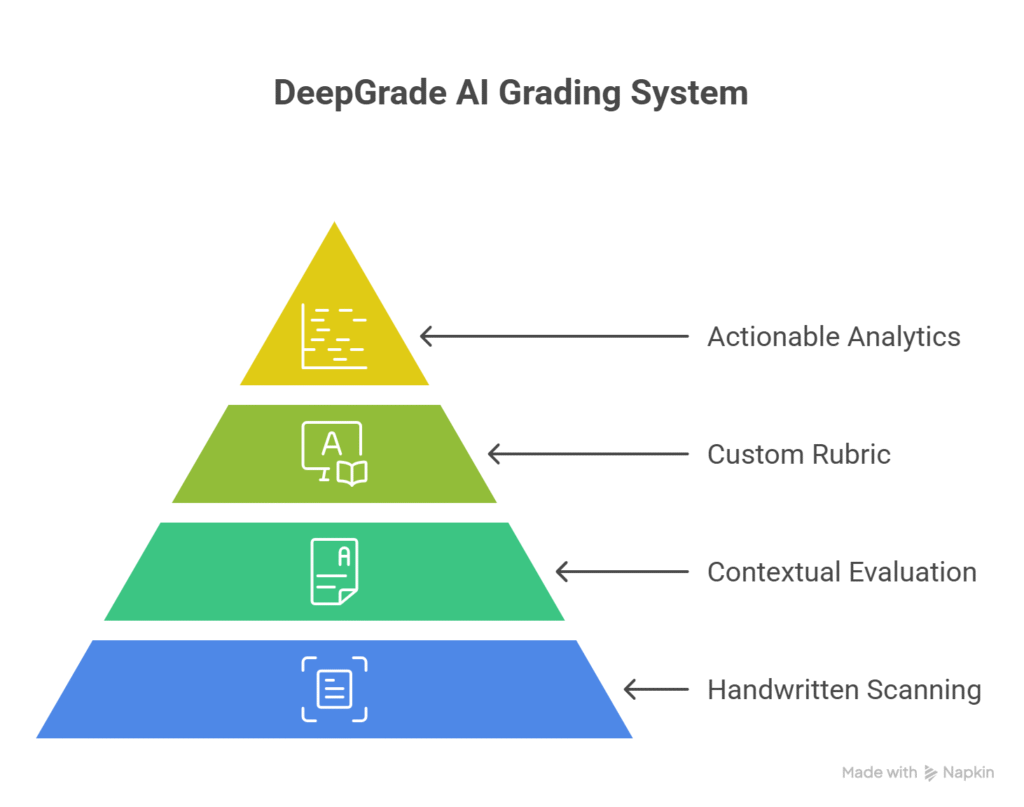
It’s built on a sophisticated neural network that has been trained to think like an educator. Its key features are what set it apart as a true automated grading system 2025.
- Handwritten Answer Scanning: This is a massive breakthrough. DeepGrade uses advanced Optical Character Recognition (OCR) to scan and digitize traditional, handwritten paper exams. You don’t have to change how you teach; the AI adapts to you.
- Contextual Evaluation: DeepGrade is designed for the descriptive answers that matter most. It can grade long-form essays, short-answer questions, history papers, science reports, and even diagrams with labels.
- Custom Rubric Engine: This is the most important part. You, the educator, are still in complete control. You define your grading rubric. You tell the AI exactly what to look for and how to score it. DeepGrade then applies your rubric with perfect, unbiased consistency.
- Actionable Analytics: This is its “killer feature.” DeepGrade doesn’t just give you a list of scores. It gives you a “heatmap” of your class’s understanding. You get chapter-wise performance analytics that show you, “72% of the class misunderstood the core concept in Chapter 3.” This is data you can act on.
ChatGPT-based Essay Evaluation
DeepGrade harnesses the power of next-generation Large Language Models (LLMs), the same core technology behind tools like ChatGPT. But this isn’t just a generic chatbot. It’s a highly trained and controlled ChatGPT grading system for education.
Here is the difference. If you ask a public chatbot to “grade this essay,” it will give you a generic, often inaccurate, opinion.
DeepGrade’s AI is different.
- It’s Trained: It is trained on your custom rubric and educational standards, not the entire internet.
- It’s Specific: It doesn’t just give a grade. It provides detailed, constructive feedback for each criterion you set. For example:
- Argument Strength (40%): “This argument is clear, but it lacks sufficient supporting evidence from the text.”
- Clarity of Thought (30%): “The main idea in paragraph two is strong, but the transition to paragraph three is unclear.”
- It’s Safe & Secure: It operates in a closed, secure environment, ensuring student data privacy and academic integrity.
This is the power of AI assessment tools. It’s not just a score. It’s a conversation.
Real-time Feedback Loop
This is the single biggest impact on students.
The Old Way (Traditional LMS):
- Student submits an essay.
- Two weeks later, the teacher finally finishes grading the stack.
- The student gets a single grade and a few brief comments.
- The class has already moved on to three new topics. The feedback is too late. The learning moment is gone.
The New Way (DeepGrade):
- Student submits an essay.
- Minutes later, they receive a detailed, rubric-based evaluation.
- They see exactly what they did well and where they need to improve.
- They can immediately revise their work and learn from their mistakes.
DeepGrade closes the feedback loop from weeks to minutes. It creates an active, “fail-forward” learning environment. This shift from slow, delayed feedback to instant, formative feedback is the most significant change in education technology today.
Traditional LMS Grading Systems
Now, let’s be honest about the tools most schools are forced to use. A traditional Learning Management System (LMS) is a powerful tool for organizing a course. Platforms like Canvas, Moodle, and Blackboard are excellent at hosting files, managing assignments, and tracking final scores.
But their grading “features,” like Canvas SpeedGrader, are not grading automation tools. They are manual annotation tools.
An LMS is a digital filing cabinet. DeepGrade is an intelligent processor.
Manual Workload
The workflow in a traditional LMS is a mirror of the old paper process.
- A teacher opens a student’s file.
- They read the entire document.
- They manually type comments in a box.
- They manually click on a rubric to assign points.
- They manually type the final grade.
- They click “next” and repeat the process… 149 more times.
The LMS does zero cognitive work. It doesn’t read, understand, or analyze. It is a passive tool that still demands 100% of the teacher’s time and mental energy for every single submission. This is the root of teacher satisfaction issues.
Limited Data Insights
What insights do you get from a traditional LMS? You get a gradebook. You can see the class average. You can see a bell curve.
This data tells you what the final scores were. It cannot tell you why.
An LMS cannot answer these crucial questions:
- Which specific concept from the textbook did the students struggle with?
- Was the “argument” portion of the essay weak across the entire class?
- Did students use enough supporting evidence?
To get these answers, the teacher would have to manually re-read all 150 essays, build their own spreadsheet, and perform their own analysis. No one has time for that. So, the data stays hidden, and the teacher moves on, guessing at what needs to be retaught.
Scalability Challenges
This manual process creates a terrible bottleneck that directly harms education.
Because teachers (rightfully) dread the grading workload, they actively avoid assigning the work that matters most. They replace meaningful, descriptive essay assignments with shallow, multiple-choice quizzes that are easy to grade.
The limitations of the grading system dictate the school’s curriculum. This is a complete failure of education technology. The system should support pedagogy, not limit it. This is the challenge that DeepGrade vs traditional LMS solves.
DeepGrade vs Traditional LMS: Detailed Comparison
Let’s put them side-by-side. This is the only AI grading software comparison you need.
Accuracy and Speed
Speed: This is not a contest. It’s a revolution.
- Traditional LMS: A teacher grades 150 essays. At a very fast 10 minutes per essay, that is 1,500 minutes. This is 25 hours of pure, focused work.
- DeepGrade: A teacher configures the rubric (15 minutes). The AI grades all 150 essays (5-10 minutes). The teacher then spends a few hours reviewing the AI’s suggestions and finalizing the grades (2-3 hours).
- The Result: DeepGrade transforms a 25-hour-per-assignment nightmare into a 3-hour review process. That is a time saving of 88%.
Accuracy: This is the most important, misunderstood point.
- Traditional LMS (Human Accuracy): Human grading is not the gold standard of accuracy. It is subjective, biased, and wildly inconsistent.
- Grader Fatigue: A teacher’s grade on the 150th essay is always different from the 1st.
- Human Bias: We all have unconscious biases. A student with messy handwriting or a previously poor performance might be graded more harshly.
- Inconsistency: Studies on “inter-rater reliability” show that two different teachers will often give the same essay two completely different grades.
- DeepGrade (AI Accuracy): DeepGrade is 100% consistent. It applies the teacher’s rubric with perfect, mathematical precision to every single student. It has no fatigue. It has no bias. It doesn’t know the student’s name. It only knows the work.
- The Result: DeepGrade is not just more accurate in its consistency; it is fundamentally fairer to every student.
Teacher Workload and Satisfaction
This is the human impact.
- Traditional LMS: The workload is relentless and a primary source of burnout. Teacher satisfaction plummets when they realize their “dream job” is 40% administration. They are forced to sacrifice their weekends and family time.
- DeepGrade: DeepGrade eliminates the single most-hated part of the job. It gives teachers back 10, 15, or even 20 hours per week.
- The Result: What does a teacher do with that reclaimed time?
- They plan more creative, engaging lessons.
- They spend more one-on-one time with students who are struggling.
- They can finally focus on teaching, not just grading.
- This is the key to improving teacher satisfaction. It’s the solution to burnout. It’s how you retain your best educators.
Cost Efficiency and ROI
Let’s talk about the real cost.
- Traditional LMS: The grading module is “free” with the LMS. But its cost is hidden. It’s an astronomical labor cost.
- The Math: Let’s say a school has 30 teachers.
- They each spend 10 hours/week on grading.
- That’s 300 hours of professional labor per week.
- In a 40-week school year, that’s 12,000 hours spent on manual grading.
- DeepGrade: DeepGrade is a clear, predictable SaaS subscription fee.
- The Result (ROI): DeepGrade reduces that 12,000-hour labor cost by 80-90%. The system pays for itself almost instantly. The true ROI isn’t just the time saved; it’s the value of that reclaimed time. It’s the cost of not replacing a burned-out teacher. It’s the improved student outcomes and the ability to scale your school’s curriculum without scaling your costs.
Case Study: How DeepGrade Saved 68% Teacher Time in 2025
The Client: A large, prestigious private international school in the UAE with 1,500 students in its high school.
The Problem: The school prided itself on a rigorous, writing-intensive curriculum. However, their English and Humanities departments were drowning in work. Teacher satisfaction was at an all-time low. Feedback on end-of-term essays was taking over three weeks to return to students, by which time it was useless. Their LMS was just a digital inbox for the avalanche of work.
The Solution: The school integrated DeepGrade with their existing Canvas LMS. They decided to pilot the AI grading software with the entire 10th-grade English department (220 students).
The Process:
- Rubric Setup: Teachers uploaded their existing, detailed essay rubric into DeepGrade’s system.
- AI Training: The AI was trained on this specific rubric.
- Grading: Students submitted their 5-page critical analysis essays. The AI graded all 220 submissions in under 30 minutes.
- Teacher Review: Teachers then entered the “review” mode. Instead of grading from scratch, they simply validated, fine-tuned, and approved the AI’s grades and feedback.
The Results:
- Time Saved: The total grading time for the assignment dropped from 28 hours (per teacher) to just 9 hours (mostly for review). This was a 68% reduction in workload on the very first assignment.
- Feedback Quality: The feedback students received was more detailed and more consistent than ever before. Every student received specific, actionable comments on all six rubric criteria, not just a few quick notes.
- Feedback Speed: The feedback turnaround time dropped from 3 weeks to 2 days.
- Teacher Satisfaction: The pilot teachers reported a massive drop in stress and a renewed enthusiasm for teaching. One teacher said, “For the first time in years, I’m not afraid to assign a major essay. DeepGrade gave me my job back.”
Why DeepGrade Leads the Future of AI Education
The future of education technology is not about building bigger, more complex all-in-one systems. The future is about specialized, intelligent tools that do one job perfectly.
The DeepGrade vs traditional LMS comparison is clear. The LMS is a “jack of all trades, master of none.” Its grading module is, and will always be, a low-priority feature.
DeepGrade leads the future because:
- It’s a Specialist: Our entire R&D budget is focused on one thing: building the world’s most accurate and insightful AI assessment tools.
- It Handles the Real World: It is the only platform built to handle the messy reality of education, including handwritten text and complex rubrics.
- It Delivers Analytics, Not Just Data: DeepGrade is the only tool that closes the loop between assessment and instruction. It gives teachers the chapter-wise analytics they need to act on the results and improve their teaching.
Conclusion: Smarter Grading with AILogix AI
The red pen is obsolete. The late nights spent grading are over.
Relying on a traditional LMS for grading in 2025 is like using a horse and buggy on a modern highway. It’s slow, inefficient, and holding you back. Your teachers are burning out, and your students are getting feedback that is too little, too late.
The DeepGrade vs traditional LMS debate is over. Grading automation is here, and it is a win for everyone.
DeepGrade by AILogix gives your teachers their time back. It gives your students the instant, fair feedback they crave. And it gives your institution the data-driven insights you need to build a truly world-class curriculum.
It’s time to stop grading and start teaching.
Discover how much time you can save. Schedule a personalized demo of DeepGrade today.
FAQs
How accurate is DeepGrade compared to traditional LMS grading?
DeepGrade is significantly more consistent and fair. Human grading, which is what “traditional LMS grading” is, is highly subjective and suffers from fatigue and bias. Two teachers will grade the same essay differently. DeepGrade’s AI grading software applies the teacher’s exact rubric with 95%+ consistency, every single time. It’s not just accurate; it’s objective.
Can DeepGrade handle subjective and creative answers?
Yes. This is exactly what it was built for. It uses an advanced ChatGPT grading system-style AI that is trained on your custom rubric. You can set criteria for “Creativity,” “Argument Strength,” or “Use of Voice.” The AI will then evaluate the student’s work against those subjective criteria, providing a score and written feedback for each.
How much time can teachers save using AI grading?
Studies and our own case studies show that DeepGrade can reduce the active time spent on grading by 60% to 90%. A 25-hour grading workload can be reduced to just 2-3 hours of final review. This is a revolutionary improvement in teacher satisfaction and workload.
Does DeepGrade use ChatGPT or similar models?
Yes, DeepGrade utilizes advanced, proprietary Large Language Models (LLMs), which are the same family of technology that powers ChatGPT. However, our models are specifically trained for an educational context, secured in a private environment, and controlled by your school’s custom rubrics. This makes it a safe, accurate, and powerful AI assessment tool, not a general-purpose public chatbot.
Is AI grading accepted by educational institutions?
Yes, overwhelmingly. The key is the “human-in-the-loop” model. DeepGrade is not designed to replace teachers; it’s designed to assist them. Teachers always have the final say. They review, approve, and can override any grade. This model is being rapidly adopted because it combines the efficiency and fairness of AI with the wisdom and oversight of a human educator.