The global AI in education market is projected to skyrocket to $6 billion by 2025, and for a good reason. A recent survey revealed that 83% of teachers spend over five hours per week on grading alone—time that could be spent on lesson planning, student mentoring, and professional development. This administrative burden is a leading cause of teacher burnout, creating a critical need for intelligent automation. For institutions looking to stay ahead, adopting AI grading software for schools is no longer an innovative edge; it’s an operational necessity.
The core problem is threefold: teachers are overwhelmed by the sheer volume of grading, manual evaluation is often inconsistent from one teacher to another, and students suffer from delayed feedback that hinders their learning cycle. This comprehensive buyer’s guide will navigate the complexities of choosing the right AI assessment tool for schools. We will explore technical evaluation criteria, provide a transparent pricing analysis, and present clear ROI models for educational institutions. Discover how DeepGrade by AILogix transforms assessment for UAE schools and beyond.
What is AI Grading Software and Why Schools Need It Now
AI grading software is a sophisticated tool that uses artificial intelligence, machine learning, and natural language processing to evaluate student answers, from multiple-choice questions to complex, descriptive essays and even handwritten exams. It goes far beyond simple keyword matching, understanding context, semantics, and the underlying concepts of a student’s response to provide an accurate and unbiased score.
The Teacher Burnout Crisis: 40% of Time Spent Grading
Studies consistently show that teachers spend up to 40% of their work time on grading and administrative tasks. In a typical week, this can amount to 15-20 hours spent on a single, repetitive activity. This immense pressure leads to burnout, reduces job satisfaction, and ultimately impacts the quality of teaching in the classroom.
How AI Reduces Grading Time by 90%
The most significant and immediate benefit of an AI grading tool is the massive time savings. By automating the evaluation process, schools can reduce the time spent on grading by up to 90%. What once took an entire weekend can now be completed in a matter of hours, freeing educators to focus on what they do best: teaching. This isn’t about replacing teachers; it’s about augmenting their capabilities with a powerful auto grading software for teachers.
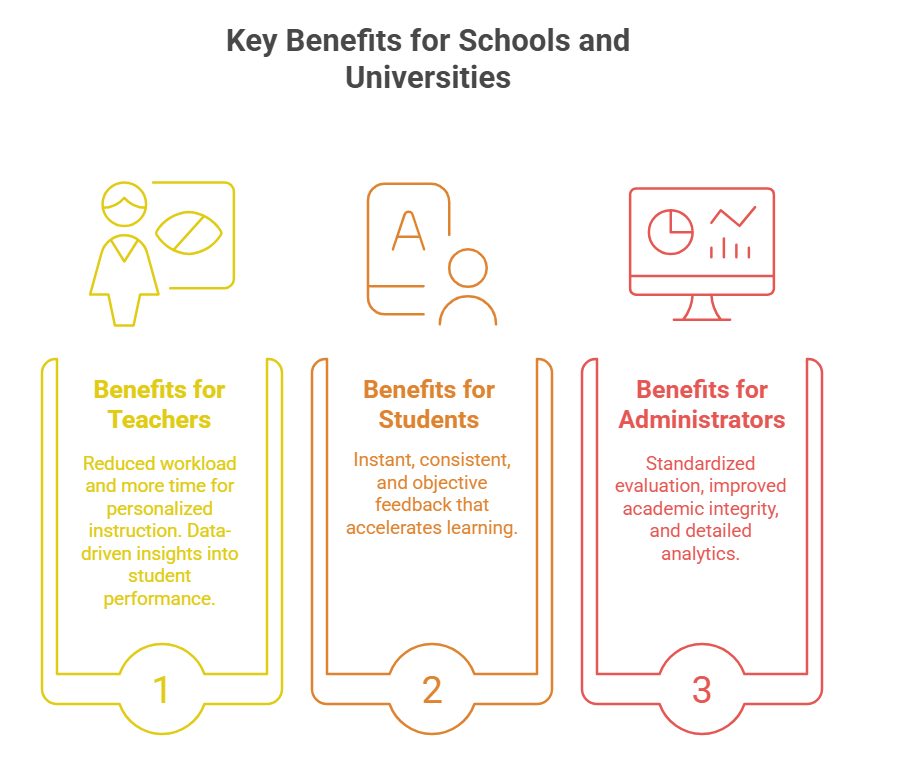
Key Benefits for Schools and Universities
- For Teachers: Reduced workload, more time for personalized instruction, and data-driven insights into student performance.
- For Students: Instant, consistent, and objective feedback that accelerates the learning process.
- For Administrators: Standardized evaluation across the institution, improved academic integrity, and detailed analytics for strategic decision-making.
The Business Case for AI Grading Investment
The investment in an artificial intelligence grading system pays for itself through operational efficiency, improved teacher retention, and enhanced academic outcomes. By automating a core, time-intensive process, schools can optimize their most valuable resource—their faculty.
Understanding AI Grading Technology: How It Works
The magic behind AI grading isn’t magic at all; it’s a combination of advanced computer science disciplines that enable a machine to read and understand human-generated text.
How Machine Learning Powers Descriptive Answer Evaluation
At its core, an AI exam evaluation tool is powered by machine learning (ML). The system is “trained” on a massive dataset of sample answers that have been previously graded by human experts. Through this training, the ML model learns to identify patterns, understand context, and recognize the key concepts that constitute a correct or high-quality answer, effectively creating a smart grading system.
Natural Language Processing vs. Rule-Based Systems
Older systems were rule-based, meaning they simply looked for specific keywords. Modern descriptive answer grading software uses Natural Language Processing (NLP), a branch of AI that allows computers to understand and interpret human language. NLP enables the software to grasp the meaning behind the words, differentiate between synonyms, and evaluate the overall coherence of an answer, not just the presence of keywords.
DeepGrade’s Approach to Handwritten and Typed Answer Assessment
DeepGrade utilizes a state-of-the-art neural network combined with advanced Optical Character Recognition (OCR). Our OCR technology can accurately digitize handwritten text, including complex scripts like Arabic. Once digitized, our proprietary NLP and ML algorithms evaluate the content against a pre-defined rubric, providing a level of nuance and accuracy that sets a new industry standard.
Real-World Use Cases: Schools, Universities, and Test Prep
- Schools: Grading weekly tests, term exams, and homework assignments.
- Universities: Evaluating thousands of semester-end exam scripts and research papers.
- Test Prep Companies: Providing instant feedback on millions of mock tests for competitive exams like NEET, JEE, and IELTS.
AI Grading Accuracy: What to Expect
A well-trained AI grading system can achieve accuracy rates of 85-92%, which is often more consistent than human grading, especially across a large number of scripts. The system’s accuracy improves over time as it processes more data and receives feedback from teachers.
15 Critical Features to Evaluate in AI Grading Software
When selecting an AI grading software, it’s crucial to look beyond the marketing and evaluate the core functionalities. Here are 15 critical features to consider.
Answer Evaluation Capabilities
This is the heart of the software. It must be able to accurately grade various answer types with high precision.
Descriptive Answer Grading Accuracy Standards
The vendor should be transparent about their accuracy benchmarks, which should ideally be above 85% for descriptive answers.
Handwritten Exam Scanning and OCR Quality
The system’s ability to accurately convert handwritten answers into digital text is paramount, especially for traditional examination formats.
Multi-Language Support (English, Arabic, Hindi)
For institutions in the UAE and the wider region, robust support for both English and Arabic is non-negotiable.
Partial Credit Assignment Logic
The AI should be intelligent enough to award partial marks for answers that are partially correct, mirroring the nuanced approach of a human grader.
Context-Aware Scoring Algorithms
The system should understand the context of the subject and the question, not just isolated words or phrases.
Assessment Types and Format Support
The software must be versatile enough to handle the diverse assessment needs of your institution.
Long-Form Essay Evaluation
Beyond short answers, the tool must be capable of evaluating the structure, coherence, and arguments of long-form essays.
NEET and JEE Mock Test Integration
For test prep centers, the software needs specialized modules to handle the specific formats and question types of competitive exams like NEET and JEE.
IELTS Writing Evaluation Capabilities
This requires advanced NLP to assess grammar, vocabulary, coherence, and task achievement according to IELTS standards.
Custom Rubric Creation Tools
Teachers must have the ability to create and customize their own grading rubrics to align with their specific curriculum and pedagogical approach.
Performance Analytics and Reporting
A grading tool should also be a powerful analytics platform, providing deep insights into student and institutional performance.
Chapter-Wise Performance Tracking Dashboards
This is a key feature of an effective chapter-wise grading system using AI. It allows teachers to identify specific topics or chapters where students are struggling.
Student Learning Outcome Analysis
The software should map student performance against defined learning objectives, providing a clear picture of academic progress.
Automated Report Card Generation
The ability to automatically generate detailed, data-rich report cards saves hundreds of administrative hours.
Integration and Workflow Management
The software must fit seamlessly into your existing technology ecosystem and daily workflows.
LMS Integration Options (Moodle, Canvas, Blackboard)
Look for pre-built integrations with popular Learning Management Systems (LMS) to ensure a smooth flow of data.
Teacher Review and Override Interface
Teachers must always have the final say. A user-friendly interface for reviewing, adjusting, and overriding AI-generated grades is essential for building trust and ensuring accuracy.
Compliance, Security, and Academic Integrity
Protecting student data and ensuring a fair assessment process are critical responsibilities.
Student Data Privacy Protection
The software must adhere to the highest standards of data security, including encryption and secure storage.
GDPR and Local UAE Compliance
For international schools and those operating in the UAE, compliance with GDPR and local data residency laws is mandatory.
Plagiarism Detection Integration
Built-in or integrated plagiarism detection tools are essential for upholding academic integrity.
AI Grading for Different Educational Institutions
The needs of a K-12 school are vastly different from a university or a test prep company. The right software should be adaptable to your specific environment.
K-12 Schools in UAE and Middle East
- Unique Challenges: Teachers often handle 5-6 classes of 30-40 students, resulting in over 200 papers to grade weekly.
- Solution Requirements: Bilingual (Arabic/English) support is crucial. The software must be simple enough for all teachers to use.
- ROI Analysis: An average teacher spends 15 hours per week grading. AI can reduce this to under 2 hours. This 13-hour saving, valuing a teacher’s time at a blended rate of 150 AED/hour, translates to potential savings of 7,800 AED/month per teacher.
Universities and Colleges
- Unique Challenges: The sheer volume of semester-end exam scripts creates massive backlogs, delaying result publication.
- Solution Requirements: The system must be capable of high-volume, high-speed processing of thousands of answer scripts.
Test Preparation Companies (NEET, JEE, IELTS)
- Unique Challenges: Scaling mock test evaluations for thousands of students requires a large team of human evaluators, which is costly and slow.
- Solution Requirements: The AI grading in test prep companies must provide instant, accurate feedback to give students a competitive edge.
EdTech Platforms and Online Learning Companies
- Unique Challenges: Manual grading is not scalable and becomes a bottleneck for user growth on online platforms.
- Solution Requirements: API access is critical for integrating the online learning answer evaluator directly into the platform’s backend.
The Complete Evaluation Checklist: RFP Requirements
Use this checklist when creating your Request for Proposal (RFP) to ensure a thorough evaluation of potential vendors.
- Technical Evaluation Criteria: Accuracy benchmarks, OCR quality, processing speed, multi-language support.
- Pedagogical and Educational Fit: Curriculum alignment, custom rubric support, quality of student feedback.
- Operational and Support Requirements: Teacher training programs, support availability in UAE time zones, system reliability.
- Financial Due Diligence: Transparent pricing, TCO analysis, clear ROI model.
- Security and Compliance Verification: Data protection policies, GDPR/UAE compliance, academic integrity features.
Implementation Best Practices for Schools
A successful implementation requires careful planning and change management.
- Phase 1: Pilot Program Design: Start small. Select 2-3 tech-savvy “champion teachers” and a few subjects to run a pilot program.
- Phase 2: Teacher Training and Change Management: Provide comprehensive, hands-on training. Address concerns and highlight the benefits to overcome resistance.
- Phase 3: School-Wide Rollout: Based on the success of the pilot, develop a gradual rollout plan for the entire institution.
AI Grading Software Cost Analysis 2025
The investment in AI grading software varies based on the size of the institution and the feature set required.
Pricing Tiers Across the Market
- Basic Plans for Small Schools: $500 – $2,000/Year (approx. 1,800 – 7,400 AED)
- Professional Plans for Medium Institutions: $5,000 – $15,000/Year (approx. 18,000 – 55,000 AED)
- Enterprise Solutions for Large Universities: $20,000 – $100,000+/Year (approx. 74,000 – 370,000+ AED)
Total Cost of Ownership (TCO) Breakdown
Consider costs beyond the subscription, including hardware (scanners), implementation fees, training, and ongoing support.
ROI Model Example: 500-Student School
A medium-sized school investing around 35,000 AED annually can expect to see a full return on investment within 12-18 months through savings in teacher time, administrative overhead, and improved efficiency.
Future Trends in AI-Powered Assessment
The technology is evolving rapidly. Here’s what to expect in the coming years.
- Real-Time Grading: AI will provide instant feedback to students as they are taking an exam.
- Adaptive Testing Integration: The system will adjust the difficulty of questions in real-time based on the student’s performance.
- Predictive Learning Analytics: AI will identify at-risk students early on by analyzing their performance trends.
- AI Teaching Assistants: AI will evolve from a grading tool to a comprehensive assistant that can answer student queries 24/7.
Making Your Final Decision: AI Grading Software Selection
Choosing the right partner is as important as choosing the right technology.
- Summary Checklist: Differentiate between “must-have” features (e.g., accuracy, security) and “nice-to-have” features (e.g., custom branding).
- Vendor Evaluation Scorecard: Create a scorecard to rate vendors across technical, operational, and financial criteria.
- Questions to Ask During Demos: How do you ensure grading accuracy for our specific subjects? What does your training and support program for UAE schools look like?
DeepGrade by AILogix: Leading AI Grading Solution
In a crowded market, DeepGrade by AILogix stands out as the premier AI grading solution for schools in the UAE and beyond.
Why DeepGrade Stands Out in the Market
DeepGrade is not just a software; it’s a comprehensive assessment ecosystem built on years of research in AI and education. Our focus is singular: to provide the most accurate, reliable, and user-friendly descriptive answer evaluation tool available.
DeepGrade’s Unique Features for UAE Schools
- Handwritten Arabic and English Support: Our OCR and NLP models are specifically trained for the nuances of both English and Arabic, achieving industry-leading accuracy of over 92%.
- Integration with Popular LMS Platforms: DeepGrade offers seamless, one-click integration with Moodle, Blackboard, Canvas, and Google Classroom.
- Pricing and Package Options: We offer flexible, transparent pricing models based on student volume, with significant discounts for large institutions.
Success Stories: Schools Using AI Grading
- Case Study 1: UAE Private School Implementation: A leading private school in Dubai implemented DeepGrade and reduced grading time for their middle school English department by 85%, allowing teachers to dedicate an extra 10 hours per week to personalized student feedback sessions.
- Case Study 2: University Reducing Grading Time by 75%: A university in Abu Dhabi used DeepGrade to evaluate 5,000 end-of-semester law exams, reducing the result publication time from three weeks to just four days.
Security, Privacy, and Ethical Considerations
- Student Data Protection Standards: We employ 256-bit AES encryption for all data, both in transit and at rest.
- GDPR and UAE Data Privacy Compliance: DeepGrade is fully GDPR compliant and offers data residency options in UAE-based data centers to comply with local laws.
- Academic Integrity Safeguards: Our platform includes audit trails for every grading decision, ensuring complete transparency and accountability.
Measuring Success: KPIs for AI Grading Implementation
- Time Savings Metrics: Track the percentage reduction in time spent on grading per teacher. Target: 70-90%.
- Accuracy and Consistency Measures: Measure inter-rater reliability between AI and teachers. Target: 95% consistency.
- Teacher Satisfaction Scores: Survey teachers before and after implementation. Target: 85%+ satisfaction.
- Student Learning Outcome Improvements: Monitor test scores and academic progress. Target: 15-20% improvement due to faster feedback.
Frequently Asked Questions About AI Grading
What is AI grading software and how does it work?
AI grading software is an advanced educational technology that uses machine learning (ML) and Natural Language Processing (NLP) to automate the evaluation of student exams. The process begins by training the AI on a large set of answers previously graded by human teachers. The AI learns the characteristics of high-quality answers, including key concepts, structure, and context. When a new exam is submitted, the software digitizes it (using OCR for handwritten papers) and then compares the student’s response to the patterns it has learned. It’s not just matching keywords; the NLP algorithms allow it to understand the meaning and intent behind the student’s writing, enabling it to grade complex, descriptive answers with remarkable accuracy.
Can AI grade descriptive answers and essays accurately?
Yes, this is one of the biggest breakthroughs in EdTech. Modern AI grading software can grade descriptive answers and essays with an accuracy rate of 85-92%. This high level of accuracy is achieved through sophisticated NLP models that evaluate multiple facets of writing, including content accuracy, argument structure, coherence, and relevance to the question. While the AI provides the initial, unbiased evaluation, the best systems always include a teacher review interface. This allows educators to quickly validate the AI’s grades and make any final adjustments, combining the speed and consistency of AI with the nuanced judgment of a professional educator.
Does AI grading software work with handwritten exams?
Absolutely. This is a critical feature for most educational institutions that still rely on traditional paper-based exams. The software uses a technology called Optical Character Recognition (OCR) to scan and convert handwritten text into a digital format that the AI can analyze. The accuracy of OCR for handwriting has improved dramatically in recent years. Leading solutions like DeepGrade have trained their OCR engines on millions of diverse handwriting samples, including cursive and print, and can even handle languages with complex scripts like Arabic. This allows schools to retain their existing examination processes while still benefiting from the speed of automated grading software for handwritten answers.
Which subjects can AI grading software evaluate?
AI grading software is remarkably versatile and can be applied across a wide range of subjects. It excels in subjects that require descriptive answers, such as History, Literature, Law, Business Studies, and Social Sciences. For STEM subjects like Physics, Chemistry, and Biology, it can evaluate conceptual answers, definitions, and explanations. Even in Mathematics, it can grade the steps and methodologies used to arrive at a solution, not just the final answer. With customizable rubrics, teachers can adapt the AI to grade virtually any subject that involves written responses, making it a comprehensive exam evaluation tool for colleges and schools.
How much does AI grading software cost for schools?
The cost of AI grading software varies widely depending on the size of the institution and the required features. For a small school, basic plans can range from $500 to $2,000 per year. Medium-sized institutions or school districts might look at professional plans costing between $5,000 and $15,000 annually. For large universities or entire ministries of education, enterprise solutions can range from $20,000 to over $100,000 per year. Most vendors, including DeepGrade, offer per-student pricing models, which provide scalability and cost-effectiveness. It’s crucial to analyze the Total Cost of Ownership (TCO), which includes any setup, training, and support fees.
What is the ROI of implementing AI grading in schools?
The return on investment (ROI) for AI grading software is compelling and typically achieved within 12 to 18 months. The primary ROI comes from massive time savings for teachers. For example, if a teacher saves 10 hours of grading per week, that’s 40 hours a month of professional time that can be redirected towards higher-value activities like student intervention and curriculum development. Secondary returns come from reduced administrative costs, faster result processing, and improved data quality for academic planning. For larger institutions, the efficiency gains can translate into hundreds of thousands of dirhams in recovered productivity annually, making the school assessment automation a financially sound decision.
Is AI grading suitable for NEET, JEE, and IELTS preparation?
Yes, AI grading is exceptionally well-suited for the high-stakes world of test preparation. Specialized modules designed for these exams provide immense value. For competitive exams like NEET and JEE, an AI tool for JEE test evaluation can grade thousands of mock tests instantly, providing students with immediate feedback on their performance and identifying weak areas at a chapter-wise level. For language proficiency tests like IELTS, an IELTS writing evaluation software can analyze essays for grammar, vocabulary, coherence, and task response, giving students the detailed, repetitive practice they need to improve their scores. This allows test prep companies to scale their operations significantly without a proportional increase in human evaluators.
How accurate is AI grading compared to human teachers?
In terms of consistency, AI grading is often superior to human grading. A human teacher’s grading can be influenced by factors like fatigue, time of day, or subconscious bias, leading to variations. An AI applies the same rubric with perfect consistency to every single paper. In terms of absolute accuracy, a well-trained AI model typically aligns with human expert graders 85-92% of the time. The key advantage of a hybrid approach is that the AI does the heavy lifting, providing a consistent baseline, and the teacher then reviews and makes final adjustments, leading to a result that is both faster and more reliable than a purely manual process.
Can AI grading software integrate with our existing LMS?
Yes, seamless integration with your Learning Management System (LMS) is a hallmark of a top-tier AI grading solution. The best software providers offer pre-built, one-click integrations for major platforms like Moodle, Canvas, Blackboard, and Google Classroom. This integration allows for a smooth workflow where teachers can assign tests within their familiar LMS environment, and grades generated by the AI are automatically synced back to the LMS gradebook. This eliminates the need for manual data entry and ensures that all assessment data is centralized in one place. Always confirm a vendor’s specific LMS integration capabilities.
Is student data safe with AI grading software?
Data security is a top priority for reputable AI grading software providers. Leading solutions employ robust security measures to protect sensitive student information. This includes using 256-bit AES encryption for all data, both when it’s being transferred and when it’s stored. They adhere to international data protection standards like GDPR and often provide data residency options, such as storing data in local UAE-based data centers, to comply with national privacy laws. Furthermore, features like role-based access control, audit logs, and regular security audits ensure that student data is always protected and accessed only by authorized personnel.
Will teachers lose their jobs because of AI grading?
No, AI grading software is designed to be a tool that augments and empowers teachers, not replace them. The goal is to eliminate the most tedious, time-consuming part of their job so they can focus on the human aspects of teaching that AI cannot replicate: mentoring students, fostering critical thinking, leading classroom discussions, and providing personalized emotional and academic support. By freeing teachers from the administrative burden of grading, AI for teachers allows them to become better educators, which ultimately leads to higher job satisfaction and improved student outcomes. The teacher’s role evolves from a simple evaluator to a true learning facilitator.
Does DeepGrade support Arabic language grading?
Yes, this is one of DeepGrade‘s key strengths and a major differentiator for the Middle East market. Our platform offers comprehensive support for grading descriptive answers in Arabic, for both typed and handwritten exams. Our AI models, including our OCR technology, have been extensively trained on Arabic text and curricula, allowing us to achieve over 92% accuracy. We are proud to be the chosen AI education Abu Dhabi and Dubai partner for numerous schools that require a reliable and accurate bilingual grading solution to serve their diverse student populations.
Conclusion: Transforming Education with AI Assessment
The adoption of artificial intelligence in education marks a pivotal shift from traditional, labor-intensive practices to a new era of efficiency, consistency, and data-driven pedagogy. As this guide has shown, AI grading software is more than a tool for saving time; it’s a catalyst for transforming the entire assessment lifecycle. It empowers teachers to reclaim their weekends and focus on high-impact instruction, provides students with the immediate, objective feedback they need to thrive, and equips administrators with the insights to drive institutional improvement.
The key factors in your decision will ultimately revolve around accuracy, ease of use, local support, and a transparent pricing model. Success is not just about choosing the right software but also about thoughtful implementation. By starting with a pilot program, training educators thoroughly, and continuously gathering feedback, you can ensure a smooth transition and maximize your return on investment. The future of assessment is not about replacing human insight but augmenting it with the power of AI. Choose a scalable, secure, and supportive partner to future-proof your institution’s academic excellence.
Ready to see the future of assessment in action? Experience DeepGrade with a free pilot program for your school and witness the transformation firsthand.