
Thinking about a new security system for your business? The first question is always the same: “What’s it going to cost?”
But the access control systems cost 2025 isn’t just one number. It’s a bundle of different expenses. Trying to budget without knowing the components is like trying to buy a car without knowing the difference between the engine, the wheels, and the seats.
Your total cost breaks down into three main parts:
- Hardware: The physical readers, locks, and controllers.
- Software: The brains you use to manage the system.
- Installation: The expert labor to get it all working.
This guide will break down the real costs for each of these parts. We’ll show you where the money goes, what the hidden fees are, and how you can build a smart, cost-effective security plan for 2025.
Why Understanding Access Control Costs Matters in 2025
Let’s be clear. Access control isn’t just an expense. It’s an investment.
The real question isn’t “What does it cost?” The real question is “What does it save you?” A single security breach can be devastating. We’re not just talking about stolen laptops. We’re talking about compliance fines, data theft, and a total loss of customer trust.
In 2025, security is more complex than ever. You have staff, visitors, and deliveries coming and going. You have compliance rules to follow. You have valuable data to protect. The cost of not having a modern access control system is a gamble most businesses can’t afford to take.
A smart system is about Return on Investment (ROI).
- It protects your physical assets from theft.
- It protects your digital assets from insider threats.
- It protects your people by creating a safe work environment.
- It can even lower your insurance premiums.
Understanding the costs helps you choose the right system. You can avoid overspending on features you don’t need or, even worse, under-spending and leaving massive security gaps.
Components of an Access Control System
Before we talk numbers, let’s look at the moving parts. Your total access control systems cost 2025 is split into these three main buckets.
Hardware: Controllers, Card Readers & Biometric Devices
This is all the physical gear you can see and touch. It’s the most visible part of your budget.
- Door Controllers: This is the “brain” of the system. It’s a box, usually hidden in a utility closet, that makes the decisions. It stores the access rules. When you tap your card, the reader sends the signal to the controller, which then decides whether to unlock the door. One controller often manages 2, 4, or 8 doors.
- Readers: This is the device you interact with at the door. Your access control hardware cost will change a lot based on which reader you pick.
- RFID/Proximity Readers: The most common type. You tap a plastic card or a key fob. The RFID card reader price is the most affordable, making it a great baseline for most offices.
- Keypad Readers: A step up. You need a card and a PIN. This two-factor (2FA) method is much more secure.
- Mobile Readers: Use your smartphone as your key. Very convenient and popular in modern offices.
- Biometric Readers: The high-security option. These scan a unique part of you. The biometric access system cost is higher, but it’s the gold standard for security because you can’t “lend” your fingerprint or your face to a coworker.
- Locking Hardware: The system needs a way to physically lock the door. This is usually an electric strike (which replaces the metal plate in your doorframe) or a magnetic lock (maglock) that holds the door shut with electromagnetic force.
Software: Cloud vs On-Premise Management
This is the “brain” you interact with. It’s the dashboard where you grant access, set schedules, and see who went where. Your choice here is the single biggest factor in your long-term cost and flexibility.
- On-Premise Software: This is the “old school” model. You buy a software license for a big, one-time fee. You install it on your own server at your office.
- Pros: You “own” it. All data stays on your site.
- Cons: Huge upfront cost. You are 100% responsible for all maintenance, security patches, and updates. If the server crashes, your system is down. It’s complex and requires a dedicated IT team.
- Cloud-Based Software (SaaS): This is the modern, 2025 standard. The software lives securely on the internet (in the cloud). You pay a predictable monthly or annual subscription fee.
- Pros: Tiny upfront cost. You can manage your entire system from a web browser or phone, anywhere in the world. Security updates and new features are automatic. It’s incredibly flexible and scalable.
- Cons: It’s an ongoing subscription (OpEx) instead of a one-time purchase (CapEx).
The access control software pricing model is shifting entirely to the cloud, and for good reason. It’s more secure, more flexible, and more cost-effective for almost everyone.
Installation: Setup, Cabling & Configuration
This is the labor, and it’s a major part of your budget. Never forget to factor in the access control installation cost.
- Cabling: This is often the biggest job. Installers have to run wires from the main controller to every single reader, lock, and door sensor. In a new building, this is easy. In an old building with concrete or brick walls, this is slow, difficult, and expensive.
- Mounting: The physical work of installing the readers on the wall, drilling the doorframe for the electric strike, and mounting the maglock.
- Configuration: The final, critical step. The technicians program the software, set up your first batch of users, create access schedules (e.g., “Employees” can get in 9-5, “Managers” 24/7), and make sure everything is working perfectly.
Detailed Cost Breakdown
Okay, let’s get to the numbers. These are 2025 estimates for a single door. Prices will vary based on your city, installer, and the brand you choose, but this gives you a solid range for your budget.
Average Hardware Pricing by System Type
This is your one-time access control hardware cost, per door.
- Basic System (RFID Card Reader)
- RFID Reader: $150 – $400
- Door Controller (shared, cost per door): $200 – $600
- Locking Hardware (Strike/Maglock): $100 – $500
- Total Hardware per Door: $450 – $1,500
- Mid-Level System (Keypad/Mobile/NFC)
- Reader (Keypad/NFC): $300 – $700
- Door Controller (shared): $200 – $600
- Locking Hardware: $100 – $500
- Total Hardware per Door: $600 – $1,800
- High-Security System (Biometric)
- Biometric Reader (Fingerprint/Face): $500 – $2,500+
- Door Controller (shared): $300 – $800
- Locking Hardware: $200 – $600
- Total Hardware per Door: $1,000 – $3,900+
As you can see, the biometric access system cost is higher due to the advanced reader, while the standard RFID card reader price keeps costs low.
Software Licensing & Subscription Models
This is your access control software pricing.
- On-Premise Software
- Upfront License Fee: $5,000 – $50,000+ (This is a one-time cost for the whole system, not per door).
- Annual Maintenance Fee: 15-20% of the license fee every year. So, a $20,000 license will cost you $3,000 – $4,000 every year, forever, just for updates.
- Cloud-Based Software (SaaS)
- Subscription Fee: $5 – $25 per door, per month.
- This fee includes the software, all security patches, all new features, and technical support. It’s a simple, predictable operating cost. For a 10-door office, you might pay $150/month. This is a massive win for most businesses.
Labor & Integration Costs
This is the one-time access control installation cost.
- Professional Labor Rates: Expect to pay $75 – $150 per hour for each certified technician.
- Cost Per Door (Simple): For a pre-wired office or a simple setup, budget $200 – $600 per door in labor.
- Cost Per Door (Complex): For an older building that needs new, difficult cabling (e.g., through concrete), budget $800 – $2,500+ per door in labor.
- Integration: If you want to connect your access control to your fire alarm, video surveillance, or HR software, this adds programming time and cost.
Total Cost Example (10-Door Office, Cloud-Based):
- Hardware: 10 Mid-Level Readers @ $600/door = $6,000
- Installation: 10 Doors @ $400/door = $4,000
- Upfront Total: $10,000
- Ongoing Software: 10 Doors @ $15/door/month = $150/month
Hidden and Ongoing Expenses
Your budget isn’t finished after installation. Many businesses get blindsided by these ongoing costs. Plan for them from day one.
Maintenance & Support
With an on-premise system, you must buy an annual support contract. If you don’t, you get no patches and no help when it breaks. This can cost thousands per year. Hardware also fails. Readers get damaged, and locks wear out. You should budget 5-10% of your initial hardware cost for annual physical maintenance. (This is another win for cloud-based access control, as software support is already included in the subscription.)
Employee Training
This is a small but critical cost. Your team needs to know how to use the system. You’ll need to train your administrators on how to add/remove users, set schedules, and pull reports. You also need to train employees on the new rules.
System Upgrades and Security Patches
This is the most dangerous hidden cost of on-premise systems. When a new security flaw is found, you are responsible for patching it. This means paying your IT staff or an integrator to log in and perform the update. If you forget, you’re left with a massive, known security hole. Cloud-based systems patch themselves. Automatically. For free. You are always protected from the latest threats without ever lifting a finger.
AI & ChatGPT in Access Control — The 2025 Advantage
This is where commercial access control gets truly smart. In 2025, it’s not just about a card opening a door. It’s about using data to make your building safer and more efficient. This is the future of AI-powered security.
Predictive Access & Anomaly Detection
AI learns the normal rhythm of your business. It knows your cleaning crew arrives at 10 PM and the IT team works late on Fridays. So, if an employee’s card, which is only used from 9-to-5, suddenly tries to access the server room at 3:00 AM on a Sunday, the AI flags it instantly. It can automatically deny access, lock the door, and send a real-time alert to a security manager. This is proactive security, not reactive.
ChatGPT for Real-time Access Monitoring
Forget complex filters and confusing reports. The next wave of access control software integrates natural language models. Your security manager won’t need hours of training. They can just type a plain-English question into a chat-like interface:
- “Show me all access denials at the main entrance yesterday.”
- “Who was the last person to enter the server room?”
- “Alert me if anyone from the sales team enters the building this weekend.”
The system just gives you the answer. It’s fast, intuitive, and unbelievably powerful.
How AILogix Helps Businesses Reduce Access Control Costs
Understanding these costs is one thing. Actively controlling them is another. This is where a smart partner like AILogix makes all the difference. We designed our entire platform to lower your total cost of ownership.
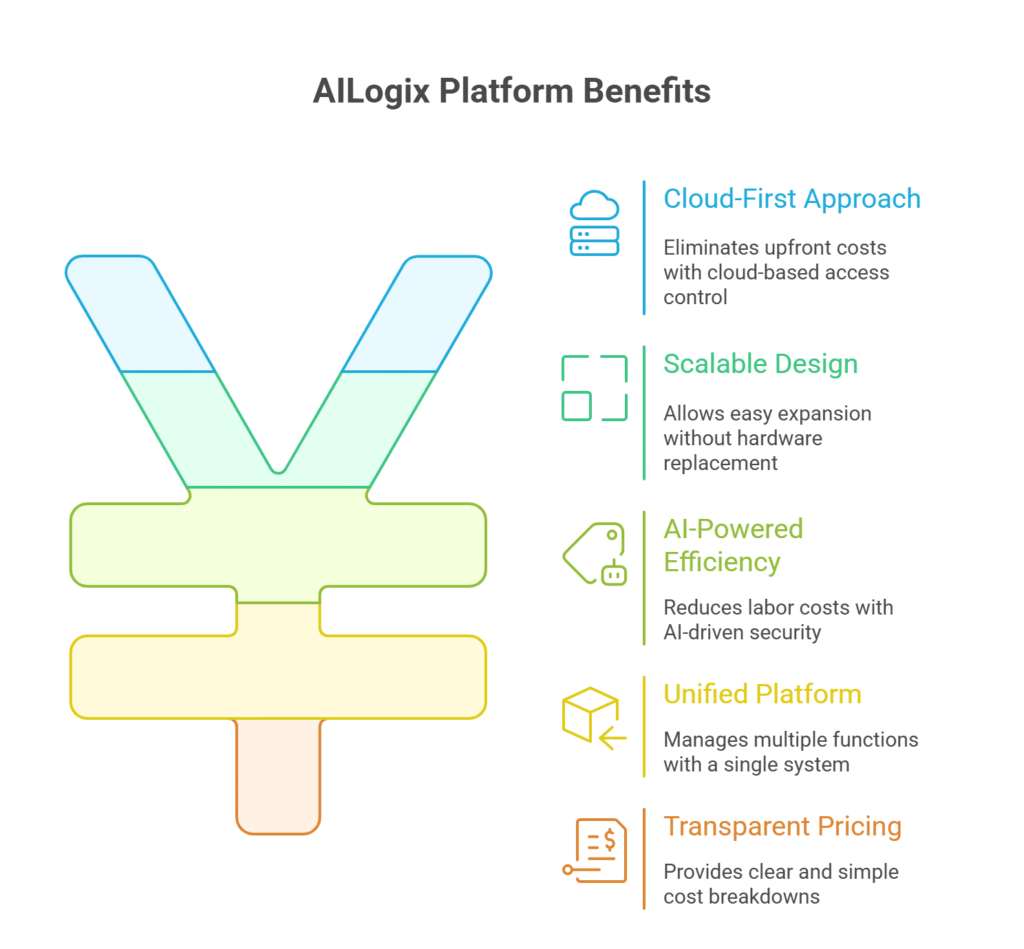
- Cloud-First, Not Cloud-Optional: We are built on cloud-based access control. This completely eliminates your largest upfront costs. There are no expensive on-prem servers to buy. There are no huge software license fees. Your access control software pricing becomes a simple, predictable, and low monthly operating cost.
- Scalable by Design: Our systems grow with you. Start with just one door. Then add five more next quarter, and another 50 at a new office next year. You never have to rip and replace your hardware. You just add what you need and your subscription adjusts.
- AI-Powered Efficiency: Our built-in AI-powered security and anomaly detection work for you 24/7. This reduces the need for a dedicated human to sit and stare at logs all day. The system is your smart assistant, saving you huge labor costs.
- One Unified Platform: AILogix isn’t just access control. It’s a single, unified platform that can also manage visitor check-in, time & attendance, and video surveillance. This means one bill, one system to learn, and zero expensive, custom-built integration projects. This radically lowers your total cost.
- Transparent, Upfront Pricing: We don’t do hidden fees. Our quotes are clear and simple. We show you the access control hardware cost, the access control installation cost, and the monthly software subscription. You know your complete budget before you ever sign.
Conclusion: Building a Secure, Cost-Effective Future
Investing in a new access control system in 2025 is a critical business decision. As we’ve seen, the final access control systems cost 2025 is a blend of your hardware choices, your installation complexity, and your software model.
The path is clear: on-premise systems are a costly, complex relic of the past. The future is flexible, scalable, and intelligent.
The smartest, most cost-effective choice for modern businesses is a cloud-based, AI-powered platform. It gives you superior security, massive flexibility, and a predictable, affordable cost structure.
Don’t just buy a box of parts and a big bill. Invest in a solution that protects your people, your data, and your bottom line for years to come.
Ready to build a smart, secure, and cost-effective access plan? Talk to an AILogix expert today. We’ll give you a clear, no-obligation quote tailored to your exact needs.
FAQs
What is the average cost of an access control system in 2025?
There’s no single “average” price, as the cost is calculated per door. For a standard commercial access control system using card readers, you should budget between $1,000 and $2,500 per door. This range typically includes all hardware, software licensing, and professional installation.
How much does access control installation cost per door?
The access control installation cost is driven by labor. For a simple installation in a pre-wired office, expect to pay $200 to $600 per door. If the building is older and requires complex new wiring (cabling) through thick walls, the labor cost can easily rise to $800 – $2,500+ per door.
What are the hidden costs in access control systems?
The biggest hidden cost is annual maintenance contracts for on-premise systems, which can be 15-20% of the initial cost, every year. Other hidden costs include IT labor for managing the system, the cost of replacing lost key cards ($5-$25 each), and the eventual need for expensive software version upgrades.
How does AI improve access control efficiency?
AI acts as a smart, 24/7 security analyst. It provides anomaly detection by spotting unusual access patterns (like an employee’s card used at 3 AM) and flagging them for review. This saves your team from having to manually review thousands of boring log entries. It makes your security proactive instead of reactive.
Is cloud-based access control more affordable than on-premise?
Yes, absolutely. On-premise systems have a massive upfront cost, often tens of thousands of dollars for servers and software licenses. Cloud-based access control has almost no upfront software cost. You pay a small, predictable monthly subscription fee per door. This makes it far more affordable to install and maintain for 99% of businesses.